
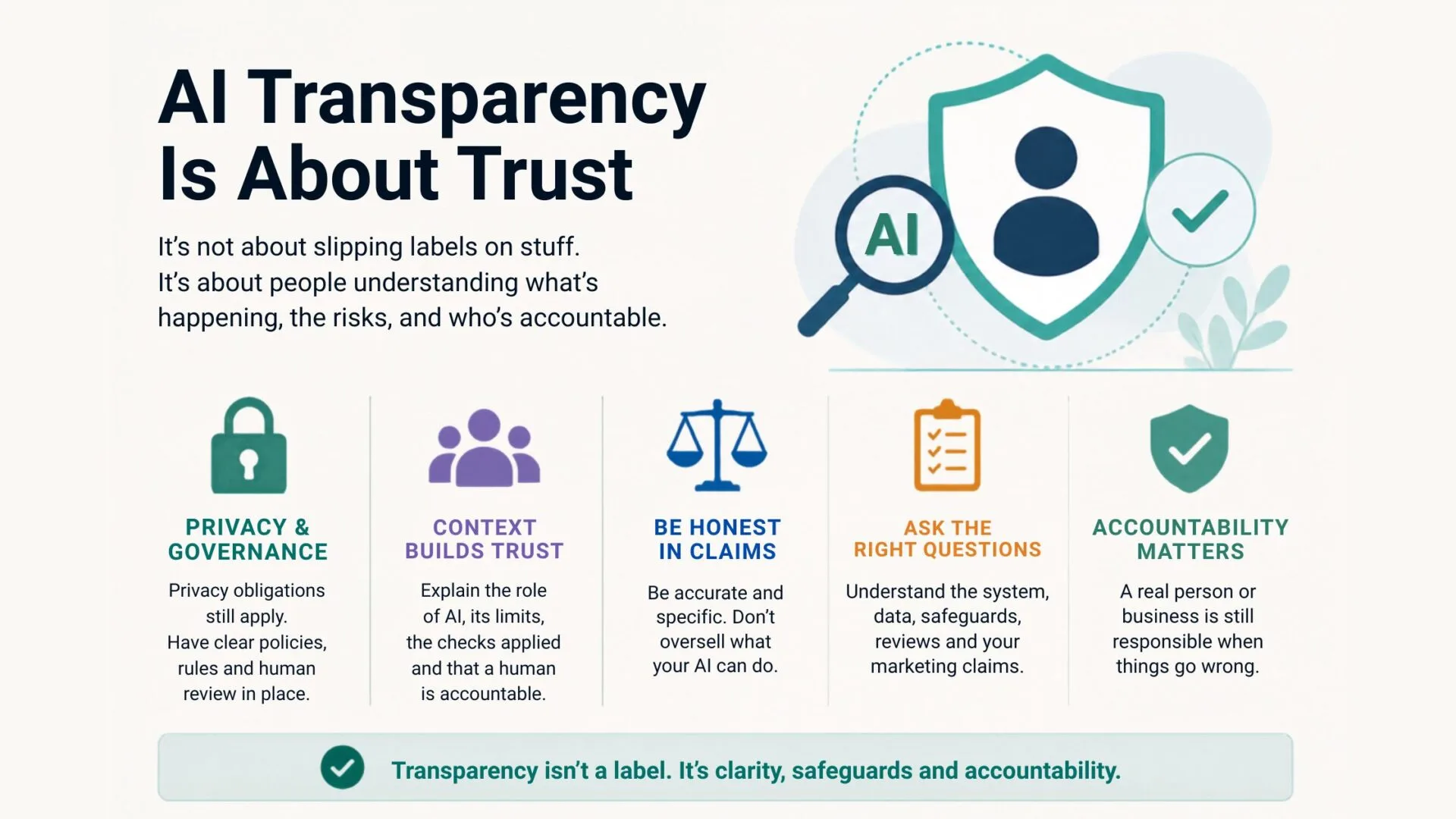
AI transparency gets talked about a lot as if it starts and ends with disclosure. Add a label. Mention AI somewhere in the fine print. Job done. Not quite.
If your business is using AI in ways that affect customers, staff or decision-making, transparency is not just about naming the tool. It is about whether people can understand what is happening, what risks are being managed, and who is still accountable when something goes wrong.
For a lot of businesses, AI is already tucked into everyday tools — summaries, drafting, search, chatbots, reporting and workflow automations. So the real issue is not whether AI touched something at all. It is whether it was used responsibly, checked properly and communicated honestly.
That is the bit that builds trust. A vague “AI-assisted” sticker on the end of a process does not.
Australian privacy obligations do not disappear because a process feels innovative. The Office of the Australian Information Commissioner has made it clear that privacy obligations can apply to personal information entered into AI systems and to outputs that contain personal information.
It also expects organisations to give clear information about how AI is being used and to think carefully before staff enter personal or sensitive information into publicly available tools. In practice, that means privacy policies, internal rules, procurement checks and human review all need to keep up with the technology.
Good AI transparency explains the role the system played, the limits of the output, the checks applied and the fact that a human is still accountable. That lines up with Australia’s voluntary AI guardrails, which focus on transparency, accountability, risk management and meaningful human oversight.
In plain English: if your business cannot explain what the tool is doing, where the data is going, what was verified and who signed off, you probably do not have transparency. You have a marketing line.
Businesses also need to be careful not to oversell what their AI can do. Under Australian Consumer Law, claims about products and services must be accurate, truthful and based on reasonable grounds.
If a business says its service is “AI-powered,” “fully automated” or more reliable than it really is, that can create a misleading impression. The safer approach is to be specific: say what the tool does, what it does not do, and what human oversight stays in place.
Before you tell people your AI use is transparent, ask yourself a few boring but important questions:
If the answer to any of those is no, the issue is not disclosure. It is governance.
AI transparency is not about slapping labels on stuff and hoping that counts as responsible use. It is about giving people enough clarity to trust the process, understand the safeguards and know that a real person or business is still accountable.
That is the standard customers, staff and regulators are moving toward — and frankly, it is the smarter way to use AI anyway.
This article is general information only and is not legal advice.
Office of the Australian Information Commissioner; Department of Industry, Science and Resources; Australian Competition and Consumer Commission; Office of the Victorian Information Commissioner.

Address:
23/111 Lewis Road, Knoxfield VIC 3180
Phone:
03 9017 5713
Email:
support@bitcollective.com.au
Site by Delve Digital