There was no big media splash. No headlines. No panic.
But on 21 May 2026 in Melbourne, one of Australia’s most senior judicial figures delivered a lecture that should have every business owner paying attention.
The Chief Justice of New South Wales, Andrew Bell AC, spoke at Melbourne Law School about directors’ duties in the era of AI, and what he outlined points clearly to where legal accountability is heading.
For small businesses, this does not feel like a board-level issue. In reality, it is. In SMEs, directors are usually the owners, and responsibility sits directly with you.
Why small business needs to pay attention
AI is already embedded in daily work across most businesses, whether it has been formally approved or not. It is being used to draft emails, summarise information, support decisions and shape strategy.
Many businesses have taken one of three positions: rapid adoption with minimal rules, restriction without alternatives, or delaying action altogether. None of these approaches provide meaningful protection or control.
The expectation on directors has not changed, but the environment has. That is where the risk begins to build.
What was actually said (and why it matters)
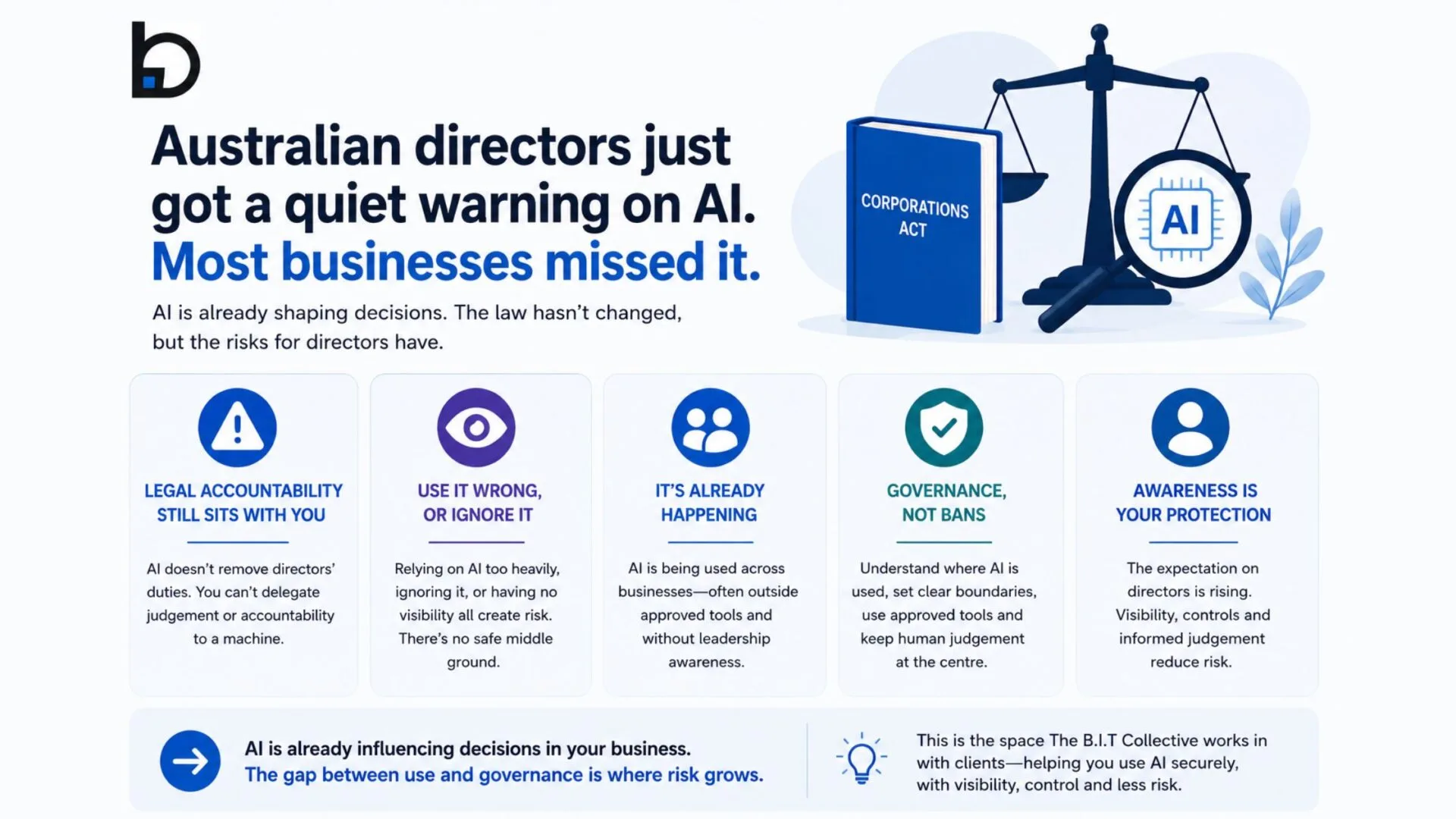
Directors rely on legal protections under the Corporations Act when decisions go wrong. Those protections assume involvement of people, independent thinking and clear accountability.
AI does not fit neatly into that structure. It is not a person, does not hold responsibility, and does not remove the requirement for judgement.
A key issue is the inability to explain how an AI system reached its conclusion. If that cannot be demonstrated, it becomes difficult to show that the output was properly assessed.
This is where it starts to get uncomfortable
The exposure is not limited to using AI incorrectly. It also arises when businesses do not engage with it at all.
Directors must remain properly informed and exercise independent judgement. As AI becomes more accessible, the expected standard of being informed increases as well.
This creates a difficult position for many businesses:
Rely too heavily on AI and the basis for legal protection weakens. Ignore it and the business risks falling below expected standards. Do nothing and it is still being used somewhere in the organisation without visibility.
What this looks like inside actual businesses
This is already happening in SMEs. Policies say one thing, behaviour often says another.
Tools may be restricted at a business level, but staff continue using personal or publicly available tools to complete their work. AI may not be formally approved for sensitive tasks, but it is still influencing how people draft, analyse and decide.
The issue is not the use itself, but where and how it is happening. In many cases it sits outside approved environments, outside governance controls and without leadership awareness.
If AI has influenced a decision that is later questioned, the process behind that decision becomes relevant. That includes the information relied on and how conclusions were reached.
So what should small business actually do?
This is not about banning AI or rolling it out everywhere without structure. It is about recognising that it is now part of business operations and needs to be managed accordingly.
Start by understanding where AI is already being used across the business. From there, introduce approved tools that sit within your environment and provide greater visibility and control.
Set practical boundaries around what can be entered into AI systems, particularly where personal, financial or commercially sensitive information is involved.
Ensure that accountability remains with people. AI can support work, but it should not replace human judgement or decision-making responsibility.
Finally, ensure leadership has a clear understanding of how AI is influencing work across the organisation. Awareness is the foundation of any effective control.
The bottom line
Most businesses are currently operating somewhere between overconfidence, restriction or lack of visibility. None of these positions are particularly strong.
AI is already shaping decisions, regardless of whether it has been formally addressed. The expectation on directors is not decreasing, and the gap between use and governance is where risk continues to grow. This is the space The B.I.T Collective is working in with clients: providing practical technology services that help businesses use AI and digital tools more securely, with better visibility, clearer controls and less unnecessary risk.