What every Victorian business should know about wearable cameras
Not long ago, smart glasses were a niche technology. Today, affordable camera-equipped glasses are available from major retailers for under $100 and are selling quickly.
That means businesses are likely to see employees, contractors, visitors and clients wearing them sooner rather than later.
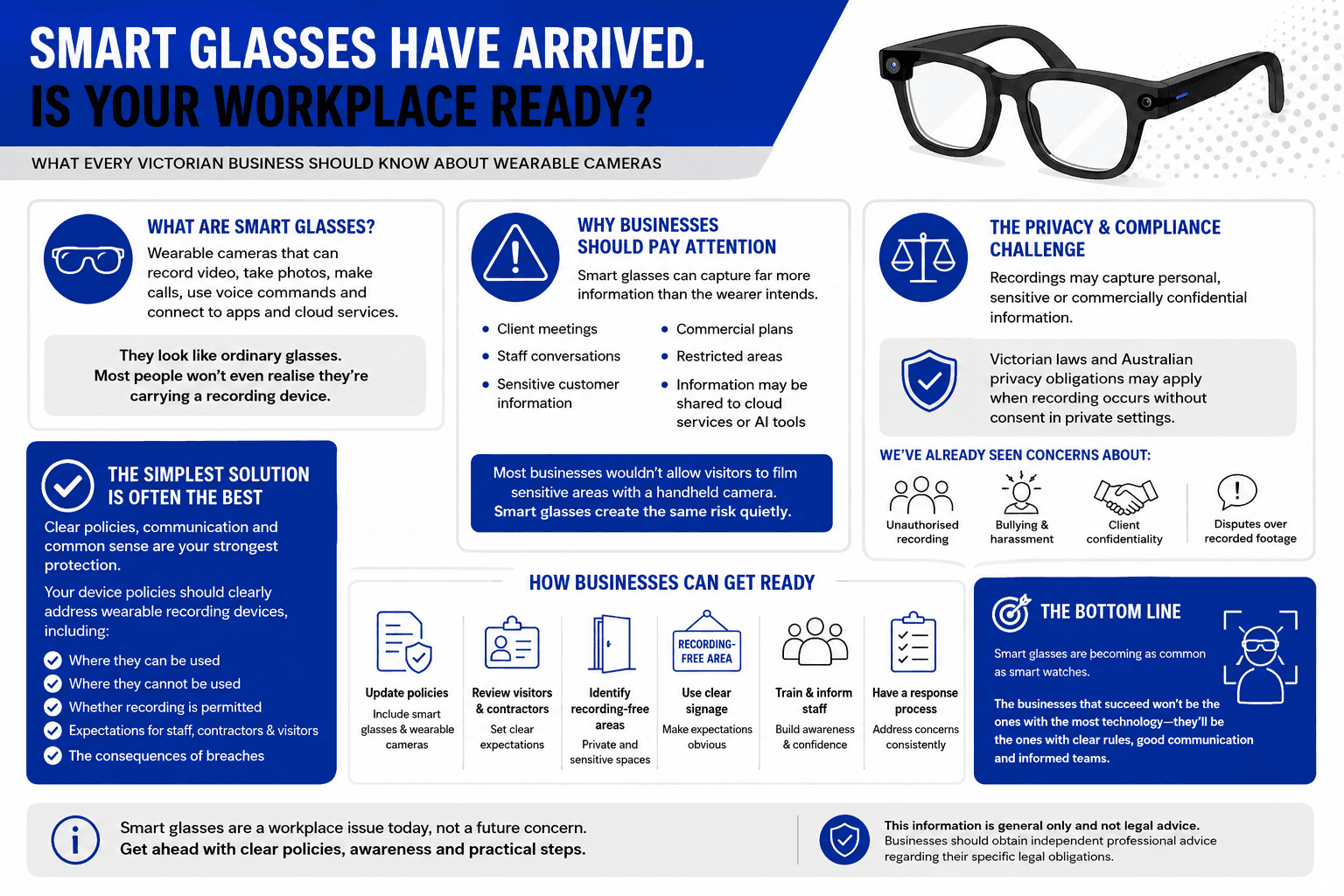
Unlike traditional cameras, smart glasses can record video, take photos, make calls and connect to cloud-based services while looking almost identical to ordinary eyewear. The challenge for workplaces is not the technology itself, but the privacy, confidentiality and workplace risks that come with it.
Why businesses should pay attention
Smart glasses can capture far more than the wearer intends.
In a typical workplace, recordings may unintentionally include:
- Confidential client discussions
- Sensitive employee information
- Customer data displayed on screens
- Commercial plans or intellectual property
- Restricted or secure areas
Many devices can also upload images and recordings to third-party cloud platforms, some of which may store or process information overseas.
Most organisations would never allow someone to openly film sensitive areas with a handheld camera. Smart glasses create a similar risk in a much less obvious way.
The privacy and compliance challenge
Depending on the circumstances, recordings may capture personal, confidential, or commercially sensitive information.
For Victorian businesses, legislation such as the Surveillance Devices Act 1999 (Vic), together with broader Australian privacy obligations, may become relevant where recordings occur without consent in situations where privacy is reasonably expected.
Beyond legal considerations, workplaces are increasingly dealing with:
- Unauthorised recording of meetings
- Employees filming colleagues
- Bullying and harassment complaints
- Confidentiality concerns raised by clients
- Disputes over recorded footage
The common issue is rarely the technology itself. It is the lack of clear expectations about its use.
The most effective response: policy, communication, and awareness
Many organisations immediately look for technical solutions. The strongest protection is usually a combination of clear policies, staff awareness, and practical workplace controls.
If your device or acceptable use policies only reference phones, laptops, and tablets, it may be time for a review.
Consider clearly addressing:
- Wearable cameras and smart glasses
- Where recording devices are permitted
- Areas where recording is prohibited
- Expectations for staff, contractors and visitors
- Consequences for policy breaches
The objective is not to ban technology. It is to ensure everyone understands the rules.
Make expectations visible
One of the simplest controls is clear signage.
Where privacy or confidentiality is important, such as meeting rooms, consultation spaces, treatment rooms, first aid rooms, change rooms or restricted areas, consider signage that clearly advises recording devices are not permitted.
Clear signage helps:
- Remove ambiguity
- Support staff when addressing concerns
- Demonstrate reasonable steps have been taken to communicate expectations
Often, a simple recording-free area notice is more effective than a lengthy policy document.
Train staff to recognise the risk
Most employees know what a phone recording looks like. Far fewer recognise modern wearable recording devices.
A brief awareness session can help staff:
- Identify smart glasses and wearable cameras
- Understand workplace expectations
- Recognise privacy and confidentiality risks
- Escalate concerns appropriately
A five-minute conversation today may prevent a significant issue tomorrow.
What should businesses do now?
Businesses do not need to overreact, but they do need a plan.
Practical next steps
- Update device and acceptable use policies
- Include wearable cameras and smart glasses in workplace rules
- Review visitor and contractor requirements
- Identify recording-restricted areas
- Install clear signage where appropriate
- Provide staff awareness training
- Establish a process for responding to privacy concerns
Affordable smart glasses mean wearable cameras are no longer a future issue. They are a workplace issue today.
The bottom line
Smart glasses are likely to become as common as smart watches over the coming years.
The businesses that adapt successfully will not necessarily be those with the most sophisticated technology controls. They will be the organisations with clear policies, strong communication and employees who understand what is expected.
At the B.I.T. Collective, we help businesses address emerging technology risks with practical, real-world solutions; from policy reviews and privacy controls to staff education and awareness.
Disclaimer: This article contains general information only and is not legal advice. Businesses should obtain independent professional advice regarding their specific legal obligations.