When Grand Theft Auto VI launched on 19 November 2026, millions of people started making decisions, solving problems and navigating the same virtual world. From an AI perspective, that kind of behavioural data could be very valuable.
Before we disappear down a conspiracy rabbit hole: Rockstar’s privacy policy confirms it collects gameplay, purchase and usage information, and creates “profile inferences” to personalise marketing. But there is no verified public evidence that Rockstar is selling GTA VI player behaviour to train AI.
The more useful story is closer to home. You don’t need to use AI to contribute to AI.
So, what are the tech giants actually doing?
Collecting information, personalising a service, improving an algorithm and training a generative AI model are different things. One does not automatically mean the others are happening. Here is what the providers say:
- Google: uses aggregated, anonymised interaction data to rank search results, and public information to train AI models such as Gemini. That doesn’t mean every private search feeds a generative AI model.
- Instagram and Facebook: Meta has confirmed that public posts, including photos and text, have been used to train its generative AI. Private posts and private messages are excluded. That public photo of your team or project may have a purpose you never intended.
- Microsoft: some consumer interactions across Bing, MSN, advertising and Copilot can contribute to AI training. For commercial Microsoft 365 Copilot, Microsoft states that organisational prompts, responses and Microsoft Graph data are not used to train its foundation models.
The product you use matters. The account you use matters. The terms you agree to matter.
Why this matters for SMEs
The biggest risk is rarely someone deliberately selling your information. It is information being collected, retained or reused in ways you haven’t considered. Think of an employee pasting a confidential client contract into a free AI tool, a website chatbot collecting customer details, or a marketing team uploading a customer database to an external platform.
None of that is malicious. Someone is simply trying to work efficiently. But convenient does not mean appropriate for business use.
What does the law say?
Privacy Act 1988 (Cth). Many small businesses with turnover of $3 million or less are exempt, but not all, including health service providers and businesses that trade in personal information. The OAIC recommends against entering personal information into publicly available generative AI tools.
New from 10 December 2026. Organisations covered by the Privacy Act must disclose in their privacy policy where a computer program uses personal information to make, or substantially and directly assist in making, decisions that could significantly affect an individual’s rights or interests, such as recruitment screening. This is not limited to generative AI.
Health Records Act 2001 (Vic). Unlike the Privacy Act, it has no small business exemption. Uploading employee medical certificates or client health records into an unapproved AI tool could create significant compliance risks.
Workplace monitoring. AI-powered monitoring may engage the Surveillance Devices Act 1999 (Vic), the OHS Act 2004 (Vic), the Fair Work Act 2009 (Cth) and the Equal Opportunity Act 2010 (Vic). Victoria’s psychological health regulations, in force since 1 December 2025, require employers to manage psychosocial hazards, which excessive surveillance can worsen.
Australian Consumer Law. If you promise customers their information is confidential or won’t be used for AI training, your providers and practices must support that promise.
What good looks like
Responsible AI adoption doesn’t need expensive compliance programs or banning technology. Start here:
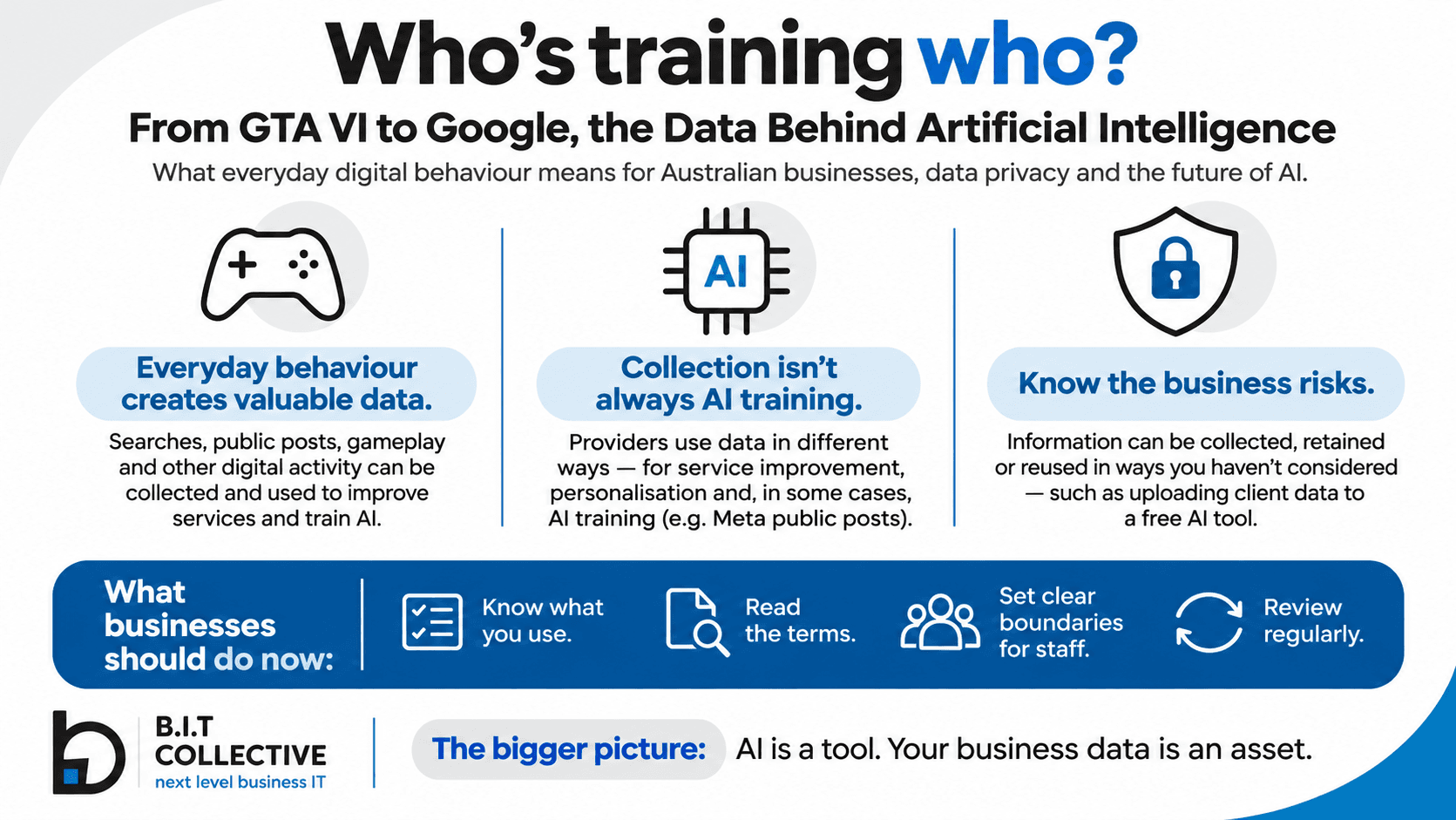
1. Know what you use. List the AI tools, extensions, transcription services and integrations across your business.
2. Read the terms. Check whether providers can retain data, train on it, share it or process it overseas.
3. Separate personal and business accounts. Use approved commercial services with suitable contractual protections.
4. Set clear boundaries. Tell staff what can’t be entered into external platforms, such as customer records, passwords, intellectual property and sensitive employee information.
5. Keep humans accountable. Use AI to assist decisions, not replace judgement, and keep your privacy policies and contracts in line with how you actually operate.
6. Review regularly. Terms and features change, so make AI governance part of ongoing risk management.
As your IT partner, B.I.T Collective can help you make AI useful without compromising the information, people and relationships that make your business valuable. We can review permissions, strengthen Microsoft 365 security and help shape practical AI usage policies.
The takeaway
We are now customers, users, content creators and, sometimes, contributors to AI development within the same interaction. That doesn’t make the technology unethical, but the benefits should come with informed decisions.
AI is a tool. Your business data is an asset. Ask not just what this technology can do for you, but what information it collects, and whether you are comfortable with that.
This article is general information only and is not legal advice. Privacy, employment and reporting obligations depend on your business, industry, turnover and the type of data you hold. Information is current as at 25 November 2026.
Sources
- Rockstar Games, Privacy Policy (last updated March 2026).
- Google, Privacy Policy and “How Search Ranking Works”.
- Meta, “Privacy Matters: Meta’s Generative AI Features”.
- Microsoft, “Data, Privacy and Security for Microsoft 365 Copilot” and Consumer Copilot Privacy FAQ.
- Office of the Australian Information Commissioner, guidance on commercially available AI products and the automated decision-making transparency requirements.
- Victorian Department of Health, Health Records Act; WorkSafe Victoria, Psychological Health.
- Australian Competition and Consumer Commission, False or misleading claims.